
The vast expanse of Earth’s oceans holds countless wonders, but perhaps none are as captivating as the creatures that inhabit its darkest depths. Far below the sun-dappled surface, in a realm of perpetual darkness and crushing pressure, life thrives in ways that challenge our understanding of biological adaptation. This article delves into the fascinating world of deep-sea creatures, exploring their remarkable adaptations and the unique environment they call home.
The Deep Sea: An Alien World on Earth
The deep sea, typically defined as the ocean layer below 200 meters, is a world apart from the familiar marine environments near the surface. As we descend into the abyss, we encounter:
- Perpetual darkness
- Extreme pressures
- Near-freezing temperatures
- Scarce food resources
Despite these harsh conditions, an incredible diversity of life has evolved to not just survive, but thrive in this challenging environment. Let’s explore the extraordinary adaptations that make this possible.
Bioluminescence
One of the most mesmerizing adaptations of deep-sea creatures is bioluminescence – the ability to produce and emit light. In the absence of sunlight, many species have evolved this captivating feature, turning the deep sea into a bioluminescent wonderland.
Functions of Bioluminescence
Bioluminescence serves multiple purposes in the deep sea:
- Attracting Prey: Some predators use light to lure curious prey within striking distance.
- Confusing Predators: Prey species may use sudden flashes of light to startle or disorient potential predators.
- Communication: Light signals can be used for communication between members of the same species.
- Camouflage: Counter-illumination helps some creatures blend in with the faint light from above.
Bioluminescent Marvels
- The Anglerfish: Perhaps the most iconic deep-sea predator, the anglerfish uses a bioluminescent lure to attract prey in the darkness.
- Comb Jellies: These gelatinous creatures produce dazzling rainbow-like displays as they move through the water.
- Flashlight Fish: These fish have light-producing organs under their eyes, which they can switch on and off like a flashlight.
Pressure Resistance
As we descend into the ocean, pressure increases dramatically – about one atmosphere for every 10 meters of depth. At the bottom of the Mariana Trench, the deepest known point in the Earth’s oceans, the pressure is more than 1,000 times that at sea level.
Adaptations for High-Pressure Environments
Deep-sea creatures have evolved remarkable ways to cope with this extreme pressure:
- Fluid-Filled Bodies: Many deep-sea fish have fluid-filled spaces in their bodies that help equalize pressure.
- Flexible Structures: Some creatures have flexible bones and scales that can compress without damage.
- Specialized Proteins: Certain deep-sea organisms have proteins that function more efficiently under high pressure.
Pressure-Defying Species
- Barrel-Eye Fish: This bizarre-looking fish has a transparent, fluid-filled dome for a head, allowing it to withstand extreme pressures.
- Mariana Snailfish: Found in the Mariana Trench, this species can survive at depths of up to 8,000 meters.
Gigantism and Miniaturization in the Deep
The deep sea has given rise to both giants and miniatures, showcasing the diverse evolutionary strategies for survival in this unique environment.
Gigantism: Going Big in the Deep
Some deep-sea creatures have evolved to enormous sizes, a phenomenon known as abyssal gigantism. Possible reasons for this include:
- Scarcity of food resources
- Reduced predation pressure
- More efficient energy conservation
Examples of Deep-Sea Giants
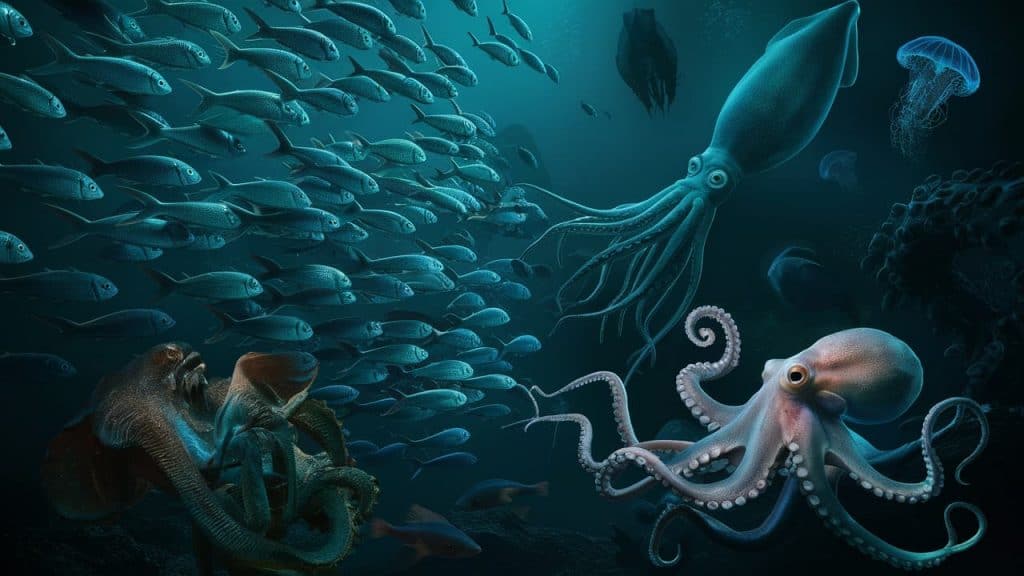
- Colossal Squid: This elusive creature can grow up to 14 meters in length and is the largest known invertebrate.
- Giant Isopod: Related to common woodlice, these crustaceans can reach lengths of up to 76 centimeters.
- Japanese Spider Crab: With a leg span of up to 3.8 meters, it’s the largest known arthropod.
Miniaturization: Small But Mighty
At the other end of the spectrum, some deep-sea creatures have evolved to be incredibly small:
- Paedocypris Fish: The smallest known vertebrate, measuring just 7.9 millimeters in length.
- Myxozoan Parasites: Some species are smaller than a single cell, with just 10-20 cells in their entire body.
Advantages of Miniaturization
- More efficient navigation in the vast water column
- Reduced energy requirements
- Ability to exploit micro-habitats
Life in Slow Motion: Adapting to Scarcity
In the cold, nutrient-poor environment of the deep sea, many creatures have adapted by slowing down their metabolic rates and life processes.
Benefits of a Slow Lifestyle
- Energy Conservation: Slower metabolism means less energy is required to survive.
- Longevity: Some deep-sea creatures can live for extraordinarily long periods.
- Reduced Food Requirements: Slow-moving creatures can survive on less frequent meals.
Examples of Slow-Living Deep-Sea Creatures
- Greenland Shark: This species can live for up to 500 years, making it one of the longest-lived vertebrates on Earth.
- Deep-Sea Corals: Some species of black corals are estimated to be over 4,000 years old.
- Glass Sponges: These ancient creatures can live for thousands of years, with some specimens dated to be over 10,000 years old.
Camouflage and Transparency
In an environment where any sign of movement or presence can attract predators, many deep-sea creatures have evolved sophisticated camouflage techniques.
Strategies for Blending In
- Transparency: Some creatures have evolved to be almost completely transparent, making them nearly invisible in the water column.
- Color-Changing Abilities: Certain species can rapidly change their colors and patterns to match their surroundings.
- Reflective Surfaces: Some fish have silvery scales that reflect what little light is available, helping them blend in.
Camouflage Champions of the Deep
- Glass Squid: These cephalopods are almost entirely transparent, with only their eyes and internal organs visible.
- Cuttlefish: While not exclusive to the deep sea, cuttlefish are masters of camouflage, able to rapidly change both color and texture.
- Mimic Octopus: This remarkable creature can imitate the appearance and behavior of various other marine animals.
Sensory Adaptations: Navigating a Dark World
Life Without Light
In the absence of sunlight, deep-sea creatures have developed enhanced senses to navigate, hunt, and communicate in their dark world.
Enhanced Sensory Abilities
- Highly Sensitive Eyes: Some species have developed extremely large eyes to capture what little light is available.
- Electroreception: The ability to detect electrical impulses from other organisms.
- Pressure Sensitivity: Some fish can detect minute changes in water pressure to locate prey or avoid predators.
- Chemical Sensing: Enhanced ability to detect chemical signals in the water.
Sensory Specialists of the Deep
- Viperfish: This fearsome predator has enormous, light-sensitive eyes to spot prey in the darkness.
- Elephant Nose Fish: While not strictly a deep-sea fish, this species showcases remarkable electroreception abilities.
- Lanternfish: These small fish have light-producing organs along their sides, possibly used for communication and species recognition.
Feeding Adaptations: Surviving in a Nutrient-Poor Environment
With scarce food resources, deep-sea creatures have evolved various strategies to maximize their chances of securing a meal.
Innovative Feeding Strategies
- Expandable Stomachs: The ability to consume large meals when the opportunity arises.
- Filter Feeding: Some creatures filter tiny particles from the water to sustain themselves.
- Opportunistic Feeding: The capacity to eat almost anything that comes their way.
Deep-Sea Feeding Specialists
- Gulper Eel: This bizarre creature has an enormous mouth and expandable stomach, allowing it to swallow prey much larger than itself.
- Giant Larvaceans: These tiny creatures create large, mucus “houses” to filter feed, playing a crucial role in the deep-sea carbon cycle.
- Zombie Worms: These unusual creatures bore into whale bones on the seafloor, extracting nutrients with the help of symbiotic bacteria.
Reproduction in the Abyss
The vast, dark expanse of the deep sea presents unique challenges for reproduction and ensuring the survival of offspring.
Deep-Sea Reproductive Strategies
- Bioluminescent Courtship: Some species use light displays to attract mates.
- Sexual Dimorphism: Extreme differences between males and females, often with much smaller males.
- Long-lived Larvae: Some species produce larvae that can survive for extended periods in the water column.
Remarkable Reproductive Adaptations
- Anglerfish: In some species, tiny males permanently fuse to the much larger females, essentially becoming parasitic sperm banks.
- Deep-Sea Octopuses: Some species lay eggs that take years to hatch, with the mother guarding them the entire time.
- Lizardfish: These hermaphroditic fish can change sex as needed to maximize reproductive success.
Conclusion
As we’ve explored in this article, the deep sea is home to some of the most extraordinary and bizarre creatures on our planet. From bioluminescent marvels to pressure-defying giants, the adaptations of deep-sea life showcase the incredible diversity and resilience of life on Earth.
Despite significant advances in deep-sea exploration and research, much of this vast ecosystem remains unexplored and unknown. Every expedition to the depths brings new discoveries, challenging our understanding of life’s limits and inspiring awe at the adaptability of nature.